|
|
 |
| Rapid relief, one
time anytime |
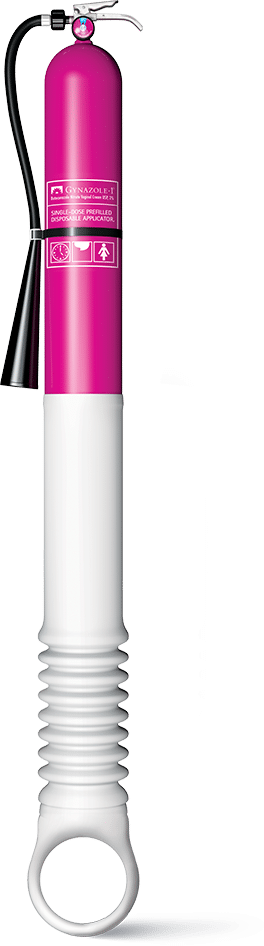
| Gynazole·1 is the
one-dose prescription therapy for vulvovaginal candidiasis (VVC) that comes in
a premeasured, prefilled, disposable applicator. This section explains the
benefits of treatment with easy-to-use Gynazole·1. |
| |
 |
| |
|
Gynazole·1 has demonstrated 94% clinical efficacy against vaginal yeast infections* (1) |
 |
|
| Investigator-blind,
multicenter, randomized, parallel, active-control study of 549 women with Candida
albicans. 97 patients received Gynazole·1 in the 3-arm study.
Patients rated symptoms on a scale from 0 (none) to 3 (severe) and were
considered clinically cured if symptoms improved to none or mild at a follow-up
examination 8–10 days post-dosing. |
| Gynazole·1: indicated
for VVC caused by all Candida species |
| Butoconazole has a low
minimum inhibitory concentration (MIC) against the most common Candida
pathogens.† (10,11) |
 |
| •
Gynazole·1 has broad-spectrum therapy with low and consistent MIC90
against all Candida species (2,1) |
|
• C pseudotropicali
|
|
• C krusei
|
|
• C rugosa
|
|
• C guilliermondii
|
|
• C lusitaniae
|
|
| • Non-albicans
species are responsible for an increasing number of vaginal yeast
infections, including 32% of recurrent yeast infections
(12-14) |
• Unlike
Gynazole·1, Diflucan® and miconazole (the active ingredient in
Monistat®) may not be as effective against some common Candida
species (2,11,15) |
 |
|
Gynazole·1 provides fast initial symptom relief to more patients than Diflucan® (1)
|
 |
| Open-label, randomized,
parallel-design study of 181 women with moderate-to-severe vaginal yeast
infections. Patients rated overall severity of itching, burning, discharge, and
irritation on a scale from 0 (no symptoms) to 10 (severe symptoms). Patients
were followed up at 5–10 days and 30 days post-dosing. |
| • In a
head-to-head clinical trial, Gynazole·1 provided faster symptom relief
from vaginal yeast infections than Diflucan (1) |
| • Gynazole·1
demonstrated significantly faster relief of symptoms than
Diflucan as early as 2 hours post-treatment (1) |
| • Same-day
relief with Gynazole·1 versus next-day relief with Diflucan (1) |
| Gynazole·1 quickly
relieves severe symptoms (2) |
 |
| Randomized,
parallel-group, investigator-blind, multicenter study of 223 patients with
vaginal yeast infections. Investigators and patients rated severity of signs
and symptoms on a scale from 0 (none) to 3 (severe). The percentage of patients
reporting severe symptoms from yeast infection with Gynazole·1 decreased from
23% to 6%, and with miconazole nitrate from 23% to 19%.
|
| • 74%
decline in the incidence of severe yeast infection symptoms within 24 hours
with Gynazole·1 |
| • 77%
more effective in providing symptom relief from yeast infection than
miconazole nitrate |
 |
| 97% of Gynazole·1 users
would use it again (1) |
| • Patients
prefer the fast relief and one-time dosing of Gynazole·1 |
| • Most
Gynazole·1 users experienced fast symptom relief in less than 24 hours |
| • In a
survey with more than 25,000 women, 97% said they would use Gynazole·1
again. (1) |
| Patients want benefits
that only Gynazole·1 delivers (1) |
 |
 |
| • Only
5.7% of total patients in clinical trials reported side effects |
| • Only
1% of adverse events were considered treatment related |
| • There
are no known drug interactions with Gynazole·1 |
| • Only
1.7% of the drug is systemically absorbed |
 |
|
Unlike oral yeast infection treatments, topical therapies like Gynazole·1 go
directly to the site of the yeast infection for fast, safe symptom relief |
|
|
| Diflucan is known to
interact with common concurrent therapies (17-22) |
 |
• Patients
taking multiple concomitant medications during
yeast infection treatment with Diflucan are at risk for
serious hepatic
toxicity (17) |
| Diflucan may have a high
risk of resistance (23) |
| • There
is a risk of resistance with repeated use of Diflucan (23) |
| • Emergence
of resistance to butoconazole, the active ingredient in Gynazole·1,
has not been seen (11) |
| Additional information
for the use of Gynazole·1 |
| Gynazole·1 vaginal
cream contains mineral oil. Mineral oil may weaken latex or rubber products
such as condoms or vaginal contraceptive diaphragms; therefore, use of such
products within 72 hours following treatment with Gynazole·1 is not
recommended. |
| Recurrent vaginal yeast
infections, especially those that are difficult to eradicate, can be an early
sign of infection with the human immunodeficiency virus (HIV) in women who are
considered at risk from HIV infection. |
| If clinical symptoms
persist, tests should be repeated to rule out other pathogens, to confirm
original diagnosis, and to rule out other conditions that may predispose a
patient to recurrent vaginal fungal infection. |
| Important Gynazole•1 Information |
|
|
|
| *Therapeutic
efficacy is based on clinical cure rate (relief of symptoms) and microbiologic
cure (pathogen eradication). The therapeutic efficacy rate after (30) days for
the one-dose treatment (Gynazole·1) was 62% as compared to 68% for the
seven-day treatment (miconazole-7). The clinical cure rate for miconazole-7 at
8 to 10 days was 96%. Based on these results, there is no statistical
difference between these treatments. (1,2) |
| †In vitro
activity may not necessarily correlate with clinical results.
|
| ‡The azoles
compared in this study were tested in 2 phases using identical methodology.
Butoconazole and fluconazole were tested in different phases of the study. (11) |
Diflucan® is a registered trademark of the Pfizer Corporation.
Monistat® is a registered trademark of McNeil-PPC.
Lipitor® is a registered trademark of the Pfizer Corporation.
Pravachol® is a registered trademark of Bristol-Meyers Squibb Company.
Zocor® is a registered trademark of Merck & Co., Inc.
Xanax® is a registered trademark of Pharmacia.
Klonopin® is a registered trademark of Roche Pharmaceuticals.
|
|