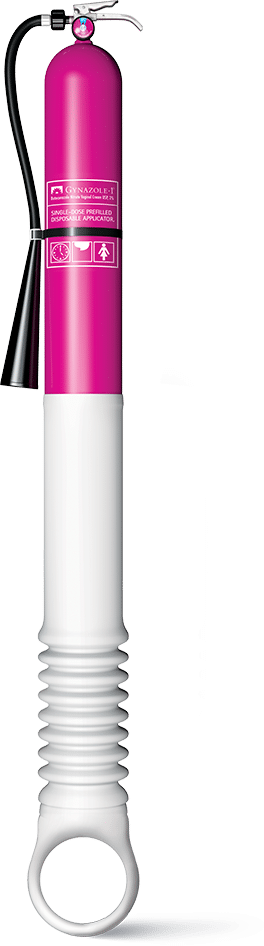
Gynazole-1® (butoconazole nitrate) Vaginal Creatm, 2% Prescribing Information
Description
Clinical Pharmacology
Indication and Usage
Contraindications
Clinical Studies
Warnings
Precautions
Adverse Reactions
Dosage and Administration
How Supplied
RX Only
Description
Gynazole·1 (butoconazole nitrate) vaginal cream, 2% contains butoconazole nitrate 2%, an imidazole derivative with antifungal activity. Its chemical name is (±)-1-[4-(p-chlorophenyl)-2-[(2,6-dichlorophenyl) thio]butyl] imidazole mononitrate, and it has the following chemical structure:
Butoconazole nitrate is a white to off-white crystalline powder with a molecular weight of 474.79. It is sparingly soluble in methanol; slightly soluble in chloroform, methylene chloride, acetone, and ethanol; very slightly soluble in ethyl acetate; and practically insoluble in water. It melts at about 159°C with decomposition.
Gynazole·1 contains 2% butoconazole nitrate in a cream of edetate disodium, glyceryl monoisostearate, methylparaben, mineral oil, polyglyceryl-3 oleate, propylene glycol, propylparaben, colloidal silicon dioxide, sorbitol solution, purified water, and microcrystalline wax.
Back to top
CLINICAL PHARMACOLOGY
Following vaginal administration of butoconazole nitrate vaginal cream, 2% to 3 women, 1.7% (range 1.3 - 2.2%) of the dose was absorbed on average. Peak plasma levels (13.6 - 18.6 ng radioequivalents/mL of plasma) of the drug and its metabolites are attained between 12 and 24 hours after vaginal administration.
Microbiology
The exact mechanism of the antifungal action of butoconazole nitrate is unknown; however, it is presumed to function as other imidazole derivatives via inhibition of steroid synthesis. Imidazoles generally inhibit the conversion of lanosterol to ergosterol, resulting in a change in fungal cell membrane lipid composition. This structural change alters cell permeability and, ultimately, results in the osmotic disruption or growth inhibition of the fungal cell.
Butoconazole nitrate is an imidazole derivative that has fungicidal activity in vitro against Candida spp. and has been demonstrated to be clinically effective against vaginal infections due to Candida albicans. Candida albicans has been identified as the predominant species responsible for vulvovaginal candidiasis.
Back to top
INDICATIONS AND USAGE
Gynazole·1 (butoconazole nitrate) vaginal cream, 2% is indicated for the local treatment of vulvovaginal candidiasis (infections caused by Candida). The diagnosis should be confirmed by KOH smears and/or cultures (see CLINICAL STUDIES).
Note: Gynazole·1 is safe and effective in non-pregnant women; however, the safety and effectiveness of this product in pregnant women has not been established. (See PRECAUTIONS: Pregnancy.)
Contraindications
Gynazole·1 is contraindicated in patients with a history of hypersensitivity to any of the components of the product.
CLINICAL STUDIES
Vulvovaginal Candidiasis: Two studies were conducted that compared 2% butoconazole nitrate cream with clotrimazole tablets. There were 322 enrolled patients, 161 received 2.0% butoconazole vaginal cream and 161 patients inserted the 500-mg clotrimazole vaginal tablet. At the second follow-up visit (30 days post-therapy), 118 patients in the butoconazole group and 116 in the clotrimazole group were evaluable for efficacy analysis, respectively. All of these patients had infection caused by Candida albicans.

The efficacy of the study drugs was assessed by evaluating clinical, mycologic and therapeutic cure rates, which are summarized in Table 1.

The therapeutic cure is defined by a complete resolution of signs and symptoms of vaginal candidiasis (clinical cure) along with a negative KOH examination and negative culture for Candida spp. (microbiologic eradication) at the long term follow-up. The therapeutic cure rate was 67% in the butoconazole group and 61% in the clotrimazole group.
Table 1
Table 1
Back to top
WARNINGS
This cream contains mineral oil. Mineral oil may weaken latex or rubber products such as condoms or vaginal contraceptive diaphragms; therefore, use of such products within 72 hours following treatment with Gynazole·1 is not recommended.

Recurrent vaginal yeast infections, especially those that are difficult to eradicate, can be an early sign of infection with the human immunodeficiency virus (HIV) in women who are considered at risk for HIV infection.
PRECAUTIONS
General: If clinical symptoms persist, tests should be repeated to rule out other pathogens, to confirm the original diagnosis, and to rule out other conditions that may predispose a patient to recurrent vaginal fungal infections.

Carcinogenesis, Mutagenesis, Impairment of Fertility:
Carcinogenesis: Long term studies in animals have not been performed to evaluate the carcinogenic potential of this drug.

Mutagenicity: Butoconazole nitrate was not mutagenic when tested in the Ames bacterial test, yeast, chromosomal aberration assay in CHO cells, CHO/HGPRT point mutation assay, mouse micronucleus, and rat dominant lethal assays.
Impairment of Fertility: No impairment of fertility was seen in rabbits or rats administered butoconazole nitrate in oral doses up to 30 mg/kg/day (5 times the human dose based on mg/M2) or 100 mg/kg/day (10 times the human dose based on mg/M2), respectively.

Pregnancy:
Pregnancy Category C

In pregnant rats administered 6 mg/kg/day of butoconazole nitrate intravaginally during the period of organogenesis, there was an increase in resorption rate and decrease in litter size; however, no teratogenicity was noted. This dose represents a 130- to 353-fold margin of safety based on serum levels achieved in rats following intravaginal administration compared to the serum levels achieved in humans following intravaginal administration of the recommended therapeutic dose of butoconazole nitrate.

Butoconazole nitrate has no apparent adverse effect when administered orally to pregnant rats throughout organogenesis at dose levels up to 50 mg/kg/day (5 times the human dose based on mg/M2). Daily oral doses of 100, 300 or 750 mg/kg/day (10, 30 or 75 times the human dose based on mg/M2 respectively) resulted in fetal malformations (abdominal wall defects, cleft palate), but maternal stress was also evident at these higher dose levels. There were, however, no adverse effects on litters of rabbits who received butoconazole nitrate orally, even at maternally stressful dose levels (e.g., 150 mg/kg, 24 times the human dose based on mg/M2).

Butoconazole nitrate, like other azole anti-fungal agents, causes dystocia in rats when treatment is extended through parturition. However, this effect was not apparent in rabbits treated with as much as 100 mg/kg/day orally (16 times the human dose based on mg/M2).

There are, however, no adequate and well-controlled studies in pregnant women. Gynazole·1 should be used during pregnancy only if the potential benefit justifies the potential risk to the fetus.

Nursing Mothers: It is not known whether this drug is excreted in human milk. Because many drugs are excreted in human milk, caution should be exercised when butoconazole nitrate is administered to a nursing woman.

Pediatric Use: Safety and effectiveness in children have not been established.
Back to top
ADVERSE REACTIONS
Of the 314 patients treated with Gynazole·1 for 1 day in controlled clinical trials, 18 patients (5.7%) reported complaints such as vulvar/vaginal burning, itching, soreness and swelling, pelvic or abdominal pain or cramping, or a combination of two or more of these symptoms. In 3 patients (1%) these complaints were considered treatment-related. Five of the 18 patients reporting adverse events discontinued the study because of them.
DOSAGE AND ADMINISTRATION
The recommended dose of Gynazole·1 is one applicatorful of cream (approximately 5 grams of the cream) intravaginally. This amount of cream contains approximately 100 mg of butoconazole nitrate.
HOW SUPPLIED: Gynazole·1 (butoconazole nitrate) vaginal cream, 2% is available in cartons containing one single-dose prefilled disposable applicator (NDC 64011- 001-08).
 
Store at 25°C (77°F); excursions permitted to 15°-30°C (59°-86°F). (See USP Controlled Room Temperature). Avoid heat above 30°C (86°F). U.S. Patent Nos. 4,078,071, 4,551,148, 4,636,202 and 5,266,329
 
Manufactured for Ther-rx Corporation
by KV Pharmaceutical Co.
St. Louis, MO 63044

P4249     08/03
Back to top
 
Important Gynazole1 Information
  Please see full Prescribing Information
  Safety Information Footnote References
 
 
Fast Relief
FOR LESS
Give your patients
$15 off their next prescription of
Gynazole1
QUICK FACTS
footnotes
Please view the
Gynazole1
Interactive Programs

to learn more about
The rapid relief of symptoms that Gynazole1 provides
The 94% efficacy of Gynazole1
Learn more about other Ther-Rx products
Anti-infectives
 - Clindesse®
Advanced Prescription
Nutritionals
 - Encora®
Prescription Prenatals
- PreCare Premier™
- PrimaCare®
- PrimaCare® ONE
- PremesisRx®
Iron Deficiency
 - Repliva 21/7 ™
 
 
Home    |    Search    |    Contact Us    |    Site Directory    |    Gynazole·1 Safety Information
Resource Library    |    Prescribing Information    |    Ther-Rx & Women's Healthcare


© 2010 Therx-Rx Corporation Terms of Use of Site